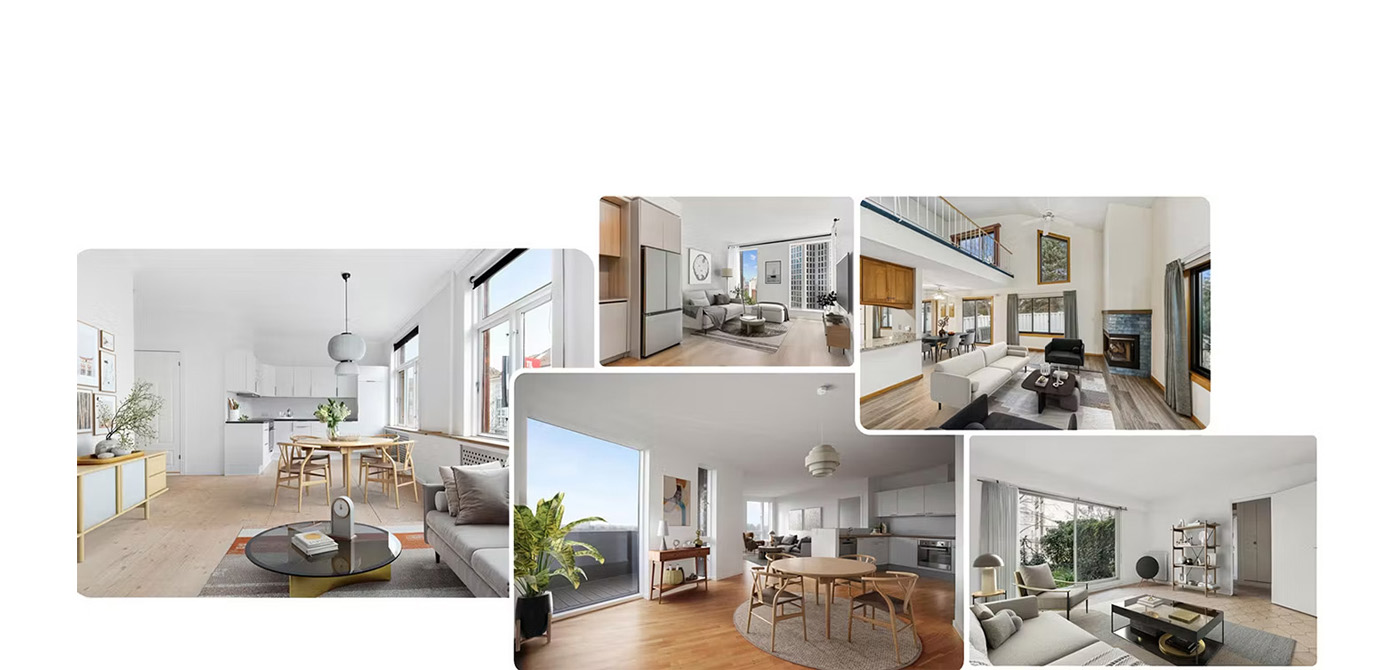
Virtual Staging
New ARMLS Watermark Rules for Digitally Altered Media
- Introduction
- A.I. Virtual Staging
- Professional and Co-Piloted Virtual Staging
- 3ds Max Renovation and Staging
- Pricing
In today's digital-first real estate market, first impressions are everything. Virtual staging has become an essential tool for transforming empty or outdated spaces into inviting homes that resonate with potential buyers. Snap2Close empowers real estate agents to stand out by providing high-quality, realistic imagery that helps buyers visualize the full potential of a property. Our Virtual Staging Options
Our Virtual Staging Options
1. AI Virtual Staging
Our most affordable and rapid solution, perfect for low-cost homes or small spaces like bedrooms. Using automated algorithms, we can deliver staged images with same-day turnaround for just $12 per image.
- Pros: Fast, budget-friendly, and convenient.
- Limitations: May lack scale accuracy and does not support "same room" consistency across multiple angles.
2. Innovative Hybrid (Professional and Co-Piloted) Virtual Staging
Our recommended "co-pilot" approach blends the speed of AI with human oversight for a complete, balanced look. For $45 per image, you get the best of both worlds: high-end 3D libraries and manual adjustments to ensure perfect scale and cohesive furniture placement throughout the home.
How It Works: The Co-Pilot Process
Our Hybrid service puts you in the driver's seat to ensure your design vision is realized:
- Step 1: Select Your Vision. Choose the photos you want staged and select a style or template from our library.
- Step 2: Setup and Upload. Snap2Close prepares your media and floor plans for processing.
- Step 3: Human Refinement. Our expert editors manually place and adjust every piece of furniture—pitch, roll, and rotation—to ensure perfect scale and positioning.
- Step 4: Delivery. Receive your final, rendered high-resolution images in 48–72 hours.
3. Professional 3ds Max Staging and Renovation
For luxury properties and complex spatial layouts, we offer professional 3D modeling using Autodesk 3ds Max. This service provides superior photorealism and virtual renovation capabilities, such as changing flooring or wall colors. Pricing ranges from $99–$119 per image.
Why Snap2Close?
We aren't just another software platform; we are your creative partner. Our co-pilot approach recognizes that you know your neighborhood and target demographic best. By combining your local insight with our human quality control and expert oversight, we deliver a level of customization and realism that pure AI simply cannot match.
The Proven Benefits
Virtual staging isn't just about aesthetics—it's a strategic investment:
- Reduced Days on Market: Staged homes can sell up to 73% faster than vacant ones.
- Higher Sale Prices: Buyers' agents report that staging can increase the dollar value of a home by 1–10%.
- Massive ROI: With low upfront costs, virtual staging often provides an ROI exceeding 500%.
A.I. Virtual Staging has revolutionized the way properties are showcased
AI Enhancing Listings with Speed and Efficiency, But What Are the Trade-offs?
As a real estate agent, you know that presenting properties in their best light is crucial for attracting potential buyers and closing deals faster. Virtual staging, which involves digitally furnishing or redecorating interior spaces, has emerged as a cost-effective and efficient alternative to traditional (physical) home staging. With the rapid advancements in artificial intelligence, AI virtual staging is now offering an even quicker and more affordable solution. But what are the real benefits and drawbacks of adopting this technology into your daily workflow? Let’s dive into the pluses and minuses.
The Pluses of A.I. Virtual Staging
AI virtual staging offers several compelling advantages for real estate professionals:
- Exceptional Cost-Effectiveness: This is perhaps the most significant benefit. While traditional home staging can cost between $800 and $2,900 per property, and traditional virtual staging ranges from $30 to $200 per image, AI virtual staging typically costs $10 per image.
- Rapid Turnaround Times: AI-powered software can stage one room in a matter of minutes, dramatically reducing the time it takes compared to the multiple hours for traditional software or days for physical staging. This speed means you can get your listings up quicker, giving you a jump on the sale. If you don’t like an AI-generated design, you can quickly resubmit and iterate until satisfied.
- Enhanced Scalability and Accessibility: With its speed and low cost, AI virtual staging makes it much more widely available to real estate agents. It provides a flexible solution for processing a large number of images quickly.
- Engaging and Inspiring for Buyers: Seeing a home staged versus unstaged is proven to decrease time on the market and increase final sales prices. AI-generated designs can inspire potential buyers and help them visualize the property’s potential, even offering design ideas they might not have considered. 81% of buyers say staging makes it easier to visualize a property as their future home.
The Minuses of A.I. Virtual Staging
Despite its advantages, AI virtual staging comes with several limitations that real estate agents should consider:
- Limited Customization: This is a frequent complaint, especially for higher-end properties or clients with specific preferences. AI tools rely on preset furniture databases and algorithms, meaning you cannot fine-tune the layout, choose specific colors, or control the scale of individual pieces like you can with a human designer. For example, you can’t easily swap one lamp for another or change pillow colors.
- Creativity Constraints and Potential for “Bad Style”: AI software is limited by its programming and lacks the nuanced understanding of space planning and design that skilled interior decorators possess. This can result in designs that are not effectively staged or appear generic, often repeating the same couch or wall art across multiple listings. In premium-class real estate, AI struggles to meet property-specific requirements and deliver the necessary level of customization, potentially appearing cheap and mass-produced.
- Potential for Errors and Visual Inconsistencies: AI can sometimes miscalculate spatial dimensions, leading to “floating” furniture, disproportionately sized items, or lighting mismatches that ignore natural light directions. It may also struggle with unusual architectural details like slanted ceilings or odd angles. Such errors can undermine buyer confidence, as photos might appear deceptive.
- Absence of the Human Touch and Authenticity: AI-staged photos can lack the human element and authentic feel. While they may look acceptable at first glance, closer inspection might reveal flaws, such as a dining table with too many legs or an altered baseboard that isn’t true to the property. This can lead to a less convincing portrayal and potential skepticism from buyers.
- Reliability Concerns for Complex Needs: AI systems may struggle with specific instructions needed for complex or unique spaces, like a pool house requiring casual furniture or a refrigerator in a particular spot.
- Limited to Single Viewpoints (Consistency Challenges): A significant drawback is AI’s inability to stage different views of the same space in a consistent manner. You might like one angle, but other viewpoints could be left vacant or staged completely differently, which can limit a potential buyer’s overall impression of the space and lower the presentation quality.
- Not Ideal for Luxury Listings: For high-end properties, where meticulous detail, authenticity, and bespoke designs are paramount, human-driven virtual staging is generally preferred. AI might offer a quick draft, but luxury listings demand maximum impact from tailored designs that AI often cannot achieve.
AI virtual staging presents a powerful tool for real estate agents, particularly when speed and budget are primary concerns, and the listing involves standard room shapes without unique architectural demands. It excels in rapidly enhancing online listings for rental properties, entry- to mid-tier homes, or early-stage marketing campaigns.
However, for luxury listings, properties with unique architectural elements, or situations requiring highly tailored designs and impeccable quality, human-driven or traditional virtual staging often yields more polished, trustworthy, and consistent results. Professional designers offer high-level design expertise, accurate proportions, and the flexibility to adapt to client preferences and market trends.
Ultimately, the choice depends on your specific needs, budget, and the type of property you are marketing. Regardless of the method, full transparency is recommended, and you should disclose that images have been virtually enhanced to maintain credibility with potential buyers.
Professional and Co-Piloted Virtual Staging
Snap2Close’s Advanced (Hybrid Co-Piloted) Virtual Staging offers significant advantages over traditional professional virtual staging, primarily through its unique “Hybrid” and “Co-Piloted” features that aim to revolutionize the industry.
These example photos illustrate how the same Living Room and Dining Room furniture pieces can be used on two separate photos of the same area.
These example photos show how the same furniture can be on mulitple photos of the same room.
Here’s why Snap2Close’s approach stands out:
You are the Co-Pilot: Enhanced Agent Involvement and Customization
- Traditionally, real estate agents’ involvement in virtual staging was limited to selecting a broad furniture style (e.g., Traditional or Contemporary) for each room. This approach often overlooked the agent’s invaluable knowledge of the property, neighborhood, and potential buyers.
- Snap2Close changes this by inviting you to “co-pilot” the process. You, the agent, actively select the bundled templates you prefer for each room. This is considered critically important because your understanding of the property provides a greater “sense of feel for the neighborhood and who the potential buyers might be”. This direct input ensures that the virtual staging is tailored to the specific property and target audience, a level of customization not typically offered in traditional methods.
The Hybrid Approach: The Best of AI Automation and Human Refinement.
- Snap2Close’s “Hybrid” staging combines the speed and efficiency of Artificial Intelligence (AI) with the precision and aesthetic judgment of human staff members. This synergy results in more realistic and aesthetically pleasing outcomes while reducing time and cost.
- The platform utilizes a higher-end version of AI virtual staging, backed by over 10,000 independently designed 3D pieces of furniture and accessories.
- These items are professionally bundled into identified and numbered templates by interior designers.
- The AI segment incorporates accurate dimensional measurements for each room, automatically creating a basic virtual 3D model.
- It then scales each individual piece of furniture and/or accessory to match the room’s virtual 3D model, which is particularly beneficial for consistency when staging multiple photos of the same room.
Human Oversight (The Hybrid Level):
- While AI handles the initial scaling and foundational work, it’s “still not perfect”. This is where staff members step in to manually adjust each single piece of 3D furniture and accessory object.
- Editors make fine-tune adjustments including Pitch, Roll, Rotation, Size, Length, Height, Width, Horizontal, Depth, and Vertical Position for each item.
- This human refinement ensures that the furniture placement is visually appealing and realistic, leveraging human expertise for customization and quality control. The result is “some amazing realistic looking virtually staged rooms”.
link to our VIRTUAL FURNITURE LIBRARY
In essence, Snap2Close’s Advanced (Hybrid Co-Piloted) Virtual Staging offers a superior option by empowering the agent with significant input (Co-Piloted) and combining the best of AI speed with human precision (Hybrid), leading to more tailored, realistic, and efficient staging results compared to traditional approaches.
Professional 3ds Max Renovation and Staging
3DS Max is a powerful 3D modeling and rendering software used for virtual renovation and staging in real estate and interior design. It allows professionals to create realistic, detailed virtual environments by modeling, texturing, lighting, and furnishing properties, effectively showcasing a property’s potential. This process is particularly useful for properties under construction, vacant properties or those needing a major makeover, providing a cost-effective alternative to traditional staging.
A real estate agent used these samples to effectively showcase the listing throughout the construction process.
Here’s a breakdown of how 3ds Max is used for virtual renovation and staging.
- Modeling the Existing Space:
A 3D artist uses 3ds Max’s tools to create a digital model of the property, room, or space. This involves using polygon modeling tools, extruding, and connecting elements to accurately represent the architectural structure. - Applying Materials and Textures:
Realistic materials and textures are applied to the walls, floors, furniture, and other elements to enhance visual appeal. 3DS Max’s material editor allows for precise control over surface properties like color, reflectivity, and bump maps. - Rendering the Final Image:
The final virtual staging or renovation is rendered using a Corona Renderer to produce high-quality, photorealistic images. Renderers offer various settings for fine-tuning the image quality, including lighting, shadows, and reflections.
- Adding Furnishings and Décor:
3D models of furniture, decorations, and other design elements are added to the scene.
These models are sourced from libraries or custom-created, allowing for a wide range of styles and options. - Lighting the Scene:
Lighting is crucial for creating a realistic and inviting atmosphere.
3ds Max allows for the placement of various light sources, including natural light from windows and artificial lights, with options to adjust intensity and color.
There is little doubt that the Snap2Close Virtual Renovation and Staging with 3DS Max software is an effective marketing tool that allows potential buyers to visualize the potential of a property and envision themselves living there.
3ds Max is the perfect product for home builders, remodelers and interior decorators.
Pricing
A.I. Virtual Staging: $12 per image
Professional and Co-Piloted Virtual Staging: $45 per image
3ds Max Renovation and Staging: $99 per image
Snap2Close Real Estate Photography
14362 N Frank Lloyd Wright Blvd, Suite 1000 Scottsdale, AZ 85260
Support: Call or Text: 480-535-8146
Email: Support@Snap2Close.com
Administrative Telephone: 480-420-8260
OFFICE HOURS
Support:
Monday-Friday 6AM-5PM
Saturday 8AM-5PM
Sunday 8AM-Noon
Photographers:
Monday-Saturday 8AM-5PM
SERVICES
HDR Photography
Synergy Flash Photography
Floor Plans
Aerial Drone
Videos (MLS & Social Media)
Interactive Media
3D Tours
Virtual Staging & Renovation
Marketing Kits & Social Media
COVERAGE AREAS
Phoenix
Scottsdale
Paradise Valley
Mesa
Chandler
Glendale
Peoria
Tempe
Surprise
Buckeye
©2026 Snap2Close Real Estate Photography LLC